Making Activity Village Visible

In our previous posts, we explored why activity villages matter and why rethinking how we age is part of embracing the full human life cycle.
With this post, we want to make the idea a little more tangible.
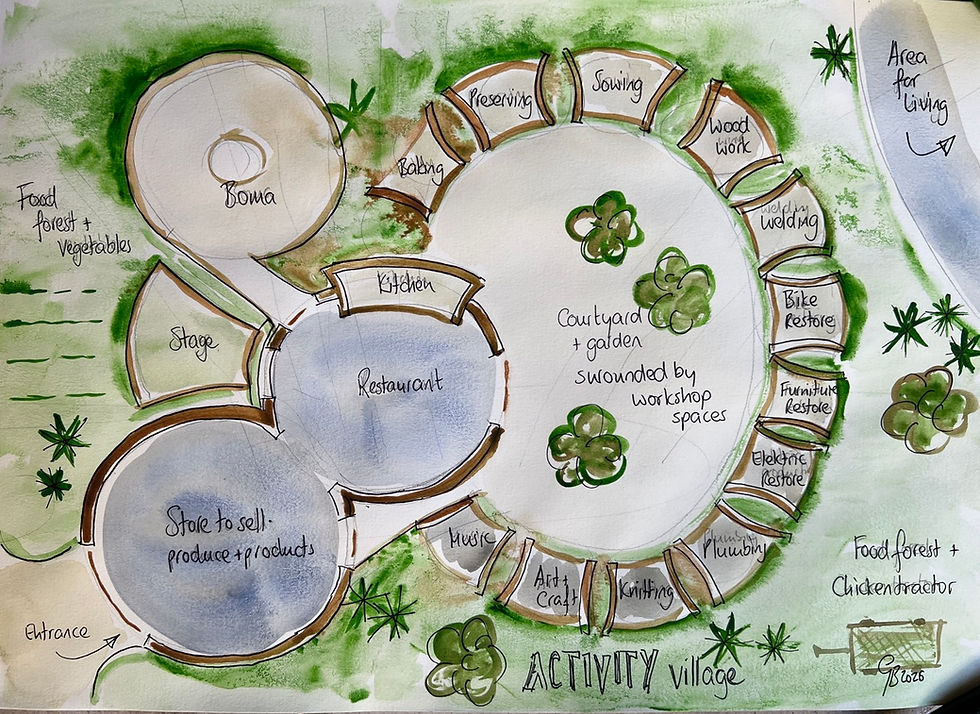
What follows is not a blueprint, nor the only way this concept could take shape. It is simply one possible interpretation, a visual way of understanding how an Activity Village might be laid out, if the land or property lends itself to it.
Because, while this concept is deeply about people, connection, and purpose across generations, it is also about finding the right kind of place where such a village could naturally emerge.
The Role of Place
An Activity Village could take many forms.
It might be a farm or property bordering a suburb, where nature guides how buildings are placed and how the village unfolds.
Or it could be an underused or abandoned industrial site, thoughtfully renovated and softened with landscaping, bringing nature back into existing structures.
Whether we bring buildings into nature, or nature back into buildings, what matters most is accessibility, for older adults, families, and the surrounding community. If a location allows people to arrive easily, linger naturally, and feel welcome, it is worth exploring.
One Possible Layout
For this example, let’s imagine a property bordering a suburb, offering enough freedom to design a village layout intentionally.
Visitors enter the village through a main entrance that leads directly to a produce and craft store; a place where items grown, made, or restored on the land can be purchased. This allows neighbours and visitors to drop in briefly, or to stay longer if they choose.
From there, a bakery, café, or restaurant forms the heart of the village; a shared, communal space that naturally connects people before they move on.
Beyond this point, the village opens into its workshop areas.
The quieter workshops come first: sewing, pottery, painting, crafting, small repairs; spaces where focus, care, and conversation coexist. Here, older adults actively practise their skills, either independently or alongside younger people joining organised workshops and learning sessions.
Further back are the louder workshops, woodworking, metalwork, welding, furniture restoration, bike repairs, and mechanical projects. These spaces are intentionally set apart, allowing creativity without disrupting the calm of the central areas.
A line of trees or green space gently marks the transition.
Behind this, there may be housing for those who choose to live within the village; close enough to walk to their workshops, yet with a separate entrance that allows privacy, independence, and easy access in and out.
If the land allows, surrounding nature could offer walking paths, cycling tracks, or gentle hiking routes, inviting movement, wellbeing, and connection with the environment.
A Place to Visit. A Life With Purpose.
This is just one way an Activity Village could come to life.
What matters most is not the exact layout, but the intention behind it: to create a place that welcomes both spectators and doers, learners and teachers, elders and younger generations.
A place people want to visit. And for some, a way of living with purpose, dignity, and connection.


Comments